
You have done the stretches. You have bought the cushioned shoes, rolled your foot over a frozen water bottle and cut back on your evening runs. Months later, that stabbing pain under your heel is still there every morning. Then someone mentions shockwave therapy, and you start wondering whether this could finally be the answer.
Shock wave treatment for plantar fasciitis has become a popular option for stubborn heel pain. But what is it exactly, does it really work, and is it right for you? Here is a clear and honest look.
In this guide, our physiotherapists in Subang Jaya explain how shockwave therapy works, what the research says, who it suits, and why exercise-based physiotherapy remains the foundation of recovery either way.
A Quick Recap: What Is Plantar Fasciitis?
The plantar fascia is a thick band of tissue that runs along the sole of your foot from the heel to the toes, supporting your arch with every step. When it is overloaded over weeks or months, it becomes irritated where it attaches to the heel bone. The result is plantar fasciitis: sharp heel pain that is usually worse with the first steps in the morning or after sitting for a while.
Most cases settle with simple, consistent care. For a full guide to exercises and treatment, read our article on plantar fasciitis physiotherapy.
What Is Shockwave Therapy?
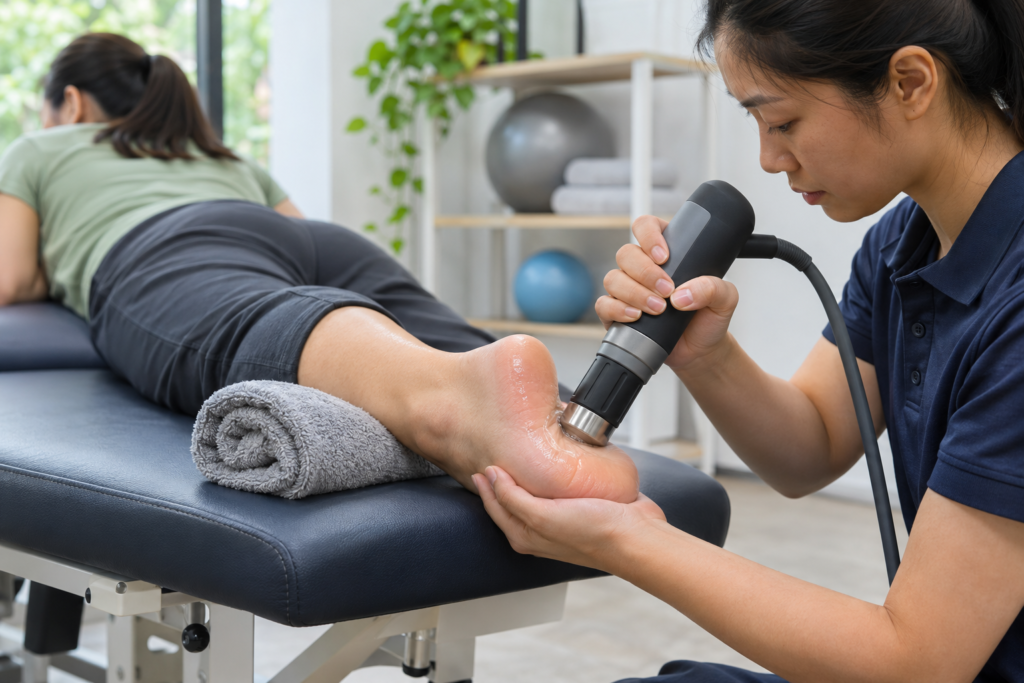
Extracorporeal shockwave therapy, usually shortened to ESWT, is a non-invasive treatment. “Extracorporeal” simply means it is applied from outside the body. A trained clinician places a handheld applicator on your heel, with a layer of gel in between, and the device delivers rapid pulses of acoustic energy into the painful area.
The idea is that these pulses stimulate the body’s own repair process in tissue that has been irritated for a long time. Shockwave is thought to boost blood flow to the area and help kick-start healing that has stalled. Researchers are still working out exactly how it works, so it is best seen as a treatment that may help, rather than a guaranteed fix.
There are two main types of machine. Focused shockwave concentrates energy on a small, deeper point, while radial shockwave spreads it over a wider, more superficial area. Both are used for plantar fasciitis, and your clinician will choose based on your symptoms and the equipment available.
Does Shock Wave Treatment Work for Plantar Fasciitis?
The honest answer is that it can help some people, but it doesn’t work for everyone.
A 2022 review published in Cureus combined the results of seven studies involving 369 patients. It found that shockwave therapy reduced pain during activity more than ultrasound therapy. However, the authors also noted that the evidence is still limited and that more research is needed. A West Suffolk NHS Foundation Trust patient leaflet describes the treatment as safe and puts the chance of it being effective at roughly 50% to 70%.
It also helps to keep the bigger picture in mind. According to the American Academy of Orthopaedic Surgeons, more than 90% of people with plantar fasciitis improve within 10 months of starting simple treatments such as stretching, supportive footwear and activity changes. Shockwave is therefore usually a next step for stubborn cases, not a first step.
The most basic difference is what each one actually is. Plantar fasciitis is a problem in the soft tissue, the fascia that supports your arch. A heel spur is a change in the bone itself. Every other difference flows from this.
Who Is Shockwave Therapy Suitable For?
Good Candidates
Shockwave therapy is generally considered for adults whose heel pain has lasted several months despite a consistent effort with other treatments. That usually means you have kept up regular stretching and strengthening, changed your footwear, adjusted your activity levels and perhaps tried physiotherapy, but the pain still isn’t settling.
Who Should Avoid It
Shockwave is not suitable for everyone. Based on guidance in the NHS patient leaflet, it is generally not offered to people who are pregnant or under 18. The same applies to people taking blood-thinning or anti-platelet medicine, people with a bleeding or clotting disorder, and those with a pacemaker or other heart device. It is also avoided where there is a foot infection, bone cancer, a history of tendon or ligament rupture, or a steroid injection in the heel within the previous 12 weeks.
If you are unsure whether any of these apply to you, talk to your doctor or therapist about your medical history and medicines before starting treatment.
What to Expect During a Shockwave Session
Before Treatment
A proper assessment should always come first. Heel pain isn’t always plantar fasciitis. Nerve irritation, a stress fracture or problems with the fat pad under the heel can feel similar, and they need different treatment. Confirming the diagnosis makes sure shockwave is being used for the right problem.
During the Session
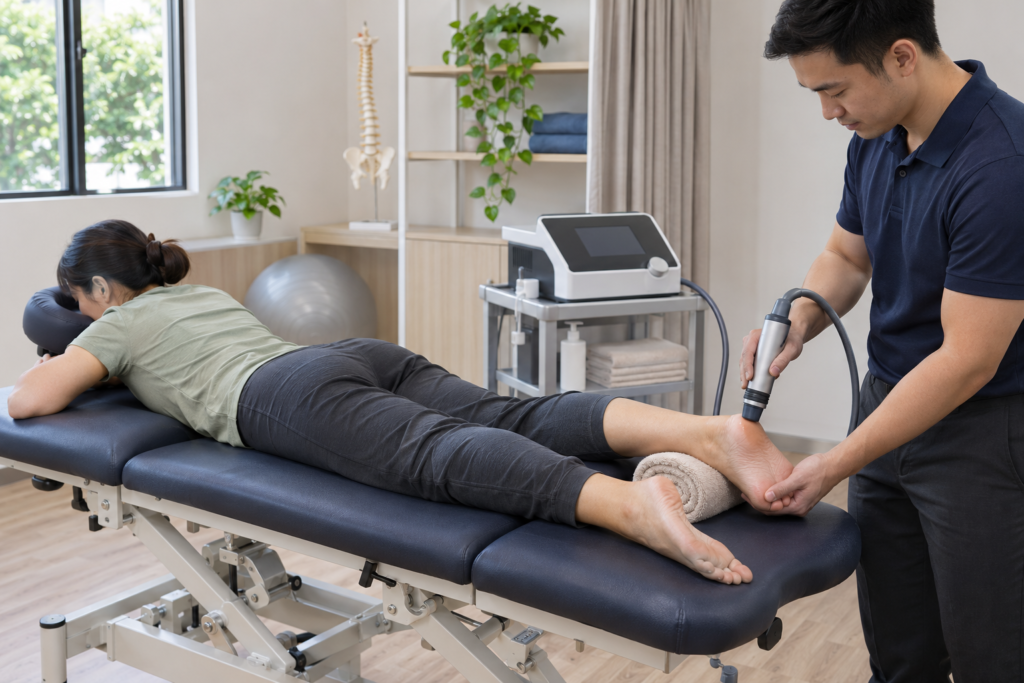
Each session usually takes around 10 minutes. You lie face down with your foot supported, gel is applied to the heel, and the applicator is moved over the sore area. Most people feel a rapid tapping or pulsing sensation. It can be uncomfortable, especially over the most tender spot, but it should stay tolerable. The clinician can adjust the intensity, and the discomfort stops as soon as the session ends.
After the Session
You can usually return to your normal daily activities and work straight away. It is best to avoid running, jumping or other strenuous or high-impact exercise for about 48 hours afterwards. Some people notice mild redness, swelling, bruising or numbness in the treated area, which usually settles within a week.
How Many Sessions You Need
A course commonly involves about three sessions, spaced one to two weeks apart. The exact number depends on your assessment and how you respond. Improvement tends to build gradually over the following weeks, so don’t be discouraged if your heel doesn’t feel completely different straight after the first session.
Shockwave vs Other Plantar Fasciitis Treatments
Shockwave is one of several options for plantar fasciitis. Here is how it compares with the other common treatments.
Treatment | What it does | When it is usually used |
Stretching and strengthening | Eases tension on the plantar fascia and builds the foot’s capacity to handle load | From the start, and throughout recovery |
Taping, footwear and insoles | Supports the arch and offloads the heel | Early on, especially for people on their feet all day |
Manual therapy and dry needling | Eases tight calf and foot muscles and improves ankle movement | Alongside exercise, to help pain and movement |
Shockwave therapy | Delivers acoustic pulses that may stimulate healing in long-standing irritation | When pain persists after several months of other care |
Steroid injection | Reduces inflammation and pain in the short term | Usually decided by a doctor for persistent, severe pain |
Why Exercise-Based Physiotherapy Still Matters
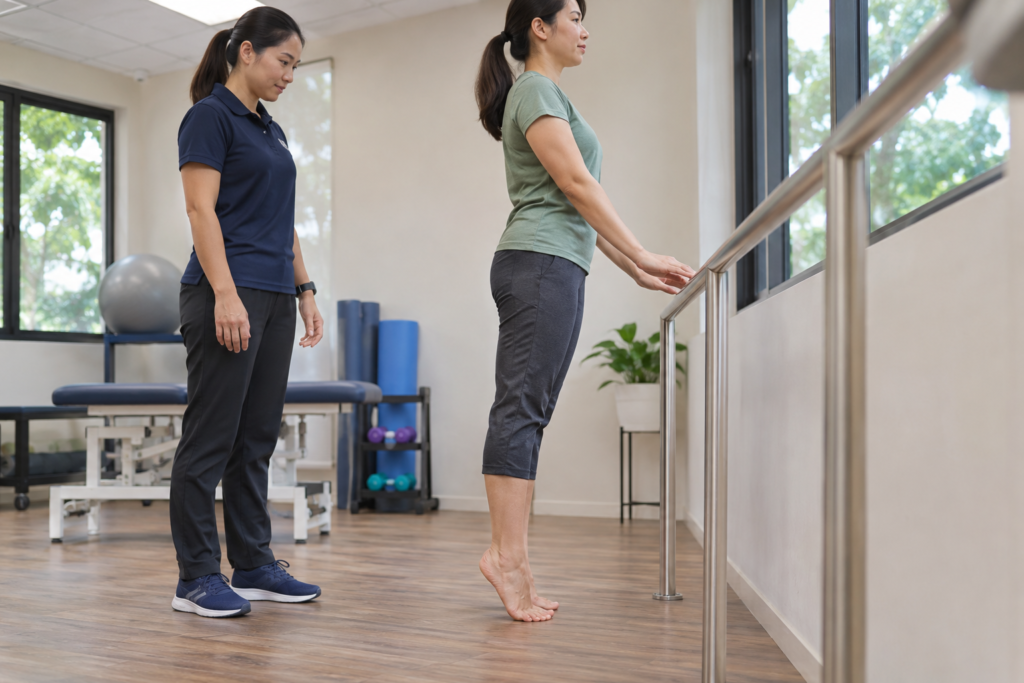
Shockwave may help calm a stubborn heel, but it doesn’t change the reasons your plantar fascia became overloaded in the first place. If those reasons are still there, the pain is more likely to return.
Tight Calves and Ankles
A tight calf or stiff ankle makes the plantar fascia work harder with every step. Regular calf stretching and ankle mobility work reduce that strain.
Weak Foot and Hip Muscles
The small muscles in your foot, along with your calf and hip muscles, help control how your foot lands and pushes off. Strengthening them helps your foot cope with load, so the fascia isn’t doing all the work.
Footwear and Daily Habits
Walking barefoot on hard floors, wearing thin flats or slippers for most of the day, or running in worn-out shoes can keep irritating the heel. Small changes here often make a big difference.
Training Load
A sudden increase in running, walking or court sports is one of the most common triggers. Physiotherapy helps you adjust your activity and then build back up at a pace your foot can handle. Our sports physiotherapy programme supports runners and active people through this process.
This is why shockwave is usually combined with an exercise programme rather than used on its own. To learn how other hands-on treatments can help, read our article on dry needling for heel pain.
How Regenesis Physiotherapy Can Help With Stubborn Heel Pain
If your heel pain just won’t go away, the first step is understanding why. At Regenesis Physiotherapy, we start with a detailed assessment of your foot, ankle, calf and hip, your footwear, and your work and training routine. This helps us pinpoint what is keeping your plantar fascia irritated.
From there, we build a treatment plan that may include hands-on manual therapy to ease tight muscles and stiff joints, and dry needling to release sensitive trigger points in the calf and foot. Supportive taping, footwear advice and a progressive exercise programme then rebuild your foot’s strength and resilience. If your physiotherapist feels shockwave or another medical treatment could help, they can talk you through the next steps.
When to See a Doctor
Most heel pain is not serious, but some signs need medical attention. See a doctor promptly if your heel pain started after a fall or injury, or if your heel is swollen, red or warm to the touch. The same applies if you have numbness or tingling in your foot, pain at night or at rest, or a fever. If you have diabetes and notice new foot pain, get it checked early, as foot problems can be more serious for people with diabetes.
Frequently Asked Questions About Shock Wave Treatment for Plantar Fasciitis
It can be uncomfortable during the session, especially over the most tender part of the heel. Most people describe a rapid tapping or pulsing feeling. The clinician can adjust the intensity so it stays tolerable, and the discomfort stops as soon as the session ends.
A course commonly involves about three sessions, spaced one to two weeks apart. The exact number depends on your assessment and how your heel responds. Shockwave usually works best when combined with a stretching and strengthening programme.
Some people notice some relief soon after a session, but improvement usually builds gradually over several weeks after the course. Results vary from person to person, and shockwave doesn't work for everyone.
Yes, you can usually walk and return to normal daily activities straight away. It is best to avoid running, jumping and other strenuous or high-impact exercise for about 48 hours after each session.
They do different jobs. Exercise-based physiotherapy addresses the reasons your plantar fascia became overloaded, such as tight calves, weak muscles and training load. Shockwave may help when pain persists despite this. The two are often used together.
Get Heel Pain Treatment at Regenesis Physiotherapy

You don’t have to keep putting up with painful mornings. At Regenesis Physiotherapy in Sunway Geo Avenue, Subang Jaya, our physiotherapists will find out what is really driving your heel pain and create a plan that fits your daily life, work and training. Learn more about how we treat hip, knee and ankle pain.
We are open 9am to 8pm, Monday to Sunday, and also offer home visits across the Klang Valley.