

Whether it is the persistent tightness that stretching never quite fixes, a strain that keeps returning every time training resumes, or a nagging ache at the back of the thigh that worsens after a long day of sitting, hamstring problems can be uncomfortable and painful.
Most hamstring problems respond well to the right approach. The difficulty is that the right approach is often the opposite of what people instinctively do.
Why The Hamstrings Can Be Vulnerable to Injury
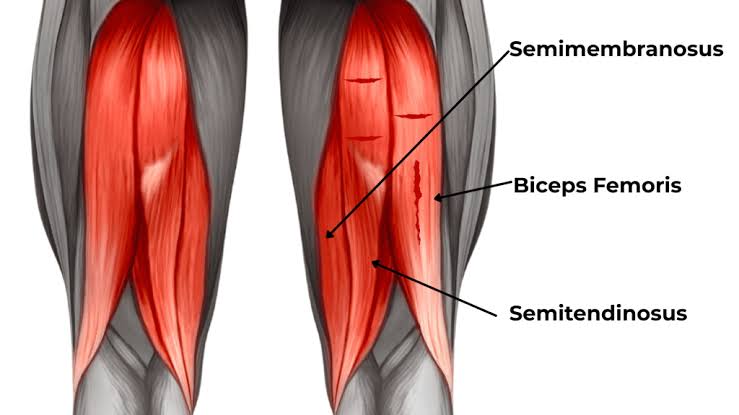
The hamstrings are a group of three muscles running along the back of the thigh: the biceps femoris on the outer side, and the semitendinosus and semimembranosus on the inner side. They originate from the sitting bone at the base of the pelvis, and attach just below the knee.
The hamstrings flex the knee and extend the hip, which means almost every lower limb movement involves them to some degree. The biggest contributor to injury in particular is using the hamstring to slow down when running. This load is typically not an issue, but it is quite demanding when adding up cumulatively as it places enormous stress on the tissue.
Additionally, most people spend the majority of their hours with their hips flexed and knees bent, keeping the hamstrings in a shortened, relatively inactive position for hours at a time. This sustained shortening contributes to both the tightness and the weakness that make hamstring problems so common in people who are otherwise active.
Why Are My Hamstrings So Tight?
Most people deal with tight hamstrings by stretching more. And this sort of works since it provides a brief release. But that tightness can come right back in a few hours. The problem with stretching is it assumes that flexibility is the problem when it’s not.
The nervous system regulates muscle tension continuously, and it increases tension in muscles that need protection. If your hamstrings still feel tight despite regular stretching, it is usually because the nervous system is maintaining that tension.
This could be because of weakness, instability, or neural sensitivity. This tension is called apparent tightness, and continuing to stretch wouldn’t give any lasting effects.
Several factors drive apparent hamstring tightness.
Weak glutes are one of the most consistent contributors. The glutes are the primary hip extensor, and when they are weak or underactive, the hamstrings are required to take on a greater share of that role. Muscles that are chronically overworked maintain higher baseline tension, and no amount of stretching will reduce that tension while the overwork continues.
Lumbar spine and sacroiliac joint dysfunction can refer tension into the hamstrings, producing a feeling of tightness that has nothing to do with the hamstring muscle itself. People with lower back problems frequently describe hamstring tightness as one of their most prominent symptoms, and treating the hamstring in isolation achieves nothing when the source is in the spine.
The sciatic nerve runs through the posterior thigh in close proximity to the hamstring muscles. When the sciatic nerve is sensitised either from a disc problem, piriformis irritation, or general neural tension, it produces a pulling, tight sensation along the back of the thigh. Stretching a sensitised nerve provokes it further rather than releasing it.
Hamstring Injuries: Types and How They Present
Hamstring Strain
A hamstring strain is the most common acute muscle injury in running and field sports. It typically occurs during sprinting or kicking. The presentation is immediate: a sudden, sharp pain in the back of the thigh that stops activity abruptly.
Hamstring strains are graded by severity:
- Grade 1 — Minor muscle fibre damage. Pain is present but the athlete can often continue with discomfort. Recovery typically takes one to two weeks with appropriate management.
- Grade 2 — A partial tear producing significant pain, swelling or bruising, and meaningful functional loss. Walking is uncomfortable and running is not possible. Recovery takes four to eight weeks.
- Grade 3 — A complete muscle rupture with severe pain, significant bruising, and an inability to use the muscle. This requires months of rehabilitation and, in cases where the proximal tendon avulses from the sitting bone, may require surgical consultation.
The recurrence rate for hamstring strains is one of the highest of any sport injury. In some sports, one in three hamstring strains is a re-injury of a previously strained hamstring.
Proximal Hamstring Tendinopathy
Proximal hamstring tendinopathy is pain at the sitting bone, where the hamstring tendons attach to the pelvis. It is distinct from a muscle belly strain, though frequently confused with one, and requires a different treatment approach.
The most reliable signs are:
- Deep aching at the sitting bone and upper thigh, particularly on hard surfaces
- Pain that is almost immediately provoked by sitting and eases within minutes of standing
- Symptoms worsened by activities that load the hamstring in a lengthened position — hill running, speedwork, and cycling with a low saddle
This sitting sensitivity is caused by direct compression of the tendon against the sitting bone. It is the clearest clinical indicator that the tendon, rather than the muscle belly, is the source of symptoms.
Referred Pain Mimicking Hamstring Tightness
A proportion of people with apparent hamstring pain or tightness do not have a hamstring problem at all. Lumbar disc pathology and sciatic nerve irritation produce symptoms along the back of the thigh that are virtually indistinguishable from a hamstring strain or chronic tightness unless specifically assessed.
Signs that the source may be neural rather than muscular include:
- Symptoms accompanied by lower back pain or stiffness
- A burning, shooting, or diffuse quality rather than a localised muscular ache
- Symptoms that change with spinal position as much as with hamstring movement
- Tightness or pain that has not responded to hamstring-specific treatment over several weeks
How to Relieve Tight Hamstrings
Correct Stretches for Temporary Relief
For apparent tightness driven by neural sensitivity or protective bracing, stretching provides temporary symptomatic relief at best.


Doorway hamstring stretch: Lie on your back in a doorway with the affected leg resting against the door frame at a comfortable angle and the other leg through the doorway on the floor. Adjust how far from the door frame you position yourself to find a comfortable stretch. Hold for 60 to 90 seconds, twice daily. This is the most effective passive stretch position for genuine hamstring flexibility work.
Standing hamstring stretch: Stand and place the heel of the affected leg on a low step or chair. Keep the back straight (do not round the lower back) and lean the torso forward from the hips until a stretch is felt in the back of the thigh. Hold for 30 seconds, repeat three times each side. Keeping the back straight ensures the stretch is in the hamstring rather than the lumbar spine.
Prone hamstring curl: Lie face down on the floor. Slowly bend the affected knee, bringing the heel toward the buttock as far as comfortable. Hold for two seconds at the top and lower slowly. Do three sets of ten repetitions.
Isometric wall push: Stand facing a wall with the affected leg bent slightly at the knee. Press the heel gently backward against the wall without allowing any movement. Hold for five seconds and release. Repeat ten times.
Bodyweight hip hinge: Stand with feet hip-width apart and a slight bend in the knees. Push the hips backward slowly, allowing the torso to tip forward while keeping the back straight, until a stretch is felt in the hamstrings. Return to standing by driving the hips forward. Repeat ten times.
During exercises, mild discomfort like a two to three out of ten on a pain scale is generally acceptable and does not indicate harm. Sharp pain, pain that worsens through a set rather than settling, or pain that is significantly worse the following day indicates the exercise is too intense for the current stage of recovery.
Move from early rehabilitation exercises to progressive strengthening when pain with the early exercises has resolved and the hamstring can be contracted fully without discomfort. A good marker is being able to perform the bodyweight hip hinge with full range and no pain before introducing the Romanian deadlift with load.
If home exercises are not producing clear improvement within two to three weeks, or if pain is preventing progression beyond the early phase, professional physiotherapy assessment will identify what is missing and provide the structured progression that home management cannot replicate.
Neural Mobilisation
When hamstring tightness has a neural component, such as when stretching consistently provokes a pulling or burning sensation rather than a muscular stretch, neural mobilisation is the more appropriate intervention.
Sciatic nerve floss: Sit upright on a chair. Slowly straighten one knee as much as comfortable while simultaneously pulling the toes toward you. Hold for two seconds, then relax both. Repeat ten to fifteen times on each side, once or twice daily. Perform this gently.
Strengthening as the Primary Treatment for Tightness
Strengthening the hamstrings directly gives the nervous system confidence that the muscle can handle the demands being placed on it, reducing the protective tension it has been maintaining. Strengthening the glutes reduces the compensatory overwork that has been driving hamstring tension. Improving core stability removes the need for the hamstrings to brace against spinal instability.
This is harder than stretching because it requires more effort and the results are less immediately obvious. But the person who consistently performs hamstring and glute strengthening exercises over eight to twelve weeks typically achieves lasting relief from chronic tightness that years of stretching failed to provide.
How Physiotherapy Can Help with Hamstring Strain
Two athletes with a Grade 2 hamstring strain can have very different presentations depending on whether the injury is proximal, mid-belly, or distal; whether neural tissue is involved; and what movement pattern or weakness drove the injury.
A physiotherapy assessment of a hamstring strain covers what caused the injury, identifying the precise location and the injury zone, and ruling out other potential reasons. Imaging is not routinely required for Grade 1 and 2 strains but is warranted for suspected Grade 3 tears.
Progressive Loading
Progressive loading is the most important phase of hamstring strain rehabilitation.The hamstring needs to be progressively strengthened through increasing ranges of motion and increasing loads before it is ready for the eccentric demands of sprinting.
Isometric exercises which involve contracting the muscle without movement begin first, typically within the first few days, as pain allows. As pain settles, isotonic exercises which are movements through range are introduced. End-range eccentric loading — working the hamstring when it is at its longest — is the critical final progression before returning to running.
Sport-Specific Rehabilitation
Pain-free jogging is not the same as being ready to sprint. To avoid reinjury, athletes have to be careful when judging their rehabilitation process.
A structured programme reintroduces running load progressively, beginning with low-speed jogging and building through moderate-pace running before introducing any high-speed work. The hamstring’s response to each session guides the pace of progression.
High-speed running and sprinting must be included in the rehabilitation programme before the athlete returns to competition. The hamstring needs to demonstrate that it can handle the load of sprinting before being returned to the environment where that load will be applied.
Criteria for return to sport include a strength symmetry of at least 90 percent between the injured and uninjured limb on hamstring strength tests, the ability to sprint at maximal or near-maximal effort without pain, completion of sport-specific movements including cutting, kicking, and acceleration, and confidence that your body is ready.

Manual Therapy
Soft tissue release of the hamstring and surrounding muscles addresses the tension that develops in the tissues adjacent to the injury during the guarding phase. This release allows exercise to be performed through a fuller range and with better muscle activation.
Dry needling is effective for reducing trigger point activity in the hamstring muscle belly, particularly in chronic presentations where areas of localised tightness and sensitivity have developed within the muscle. It is typically used as an adjunct to progressive loading rather than as a standalone treatment.
Neural mobilisation is included when sciatic nerve sensitivity is identified as a contributing factor which is common in hamstring strains involving the proximal muscle, given the close proximity of the sciatic nerve in this region.
Get Hamstring Strain Treatment at Regenesis Physiotherapy

Hamstring problems, whether it’s tightness or a strain, have specific causes that respond well to the right treatment. At Regenesis Physiotherapy, our specialists will assess the hamstring, identify the contributing factors, and build a rehabilitation plan that addresses the cause. Whether you are managing chronic pain, recovering from an injury, or trying to prevent the tightness from coming back, you will leave with a clear plan and the tools to resolve it properly.