
IT band syndrome follows a frustrating pattern. You feel pain on a run, take a few days off, and feel fine. So you head back out, only for the pain to return within minutes. Rest doesn’t fix it. Stretching the outside of your knee doesn’t fix it. Even foam rolling, which everyone recommends, only takes the edge off.
That’s because most people are treating the wrong thing.
The IT band itself isn’t the problem. It’s a symptom of how your body is moving and until you address what’s driving the issue, IT band syndrome will keep coming back every time you return to activity.
IT Band Syndrome Is a Hip Problem
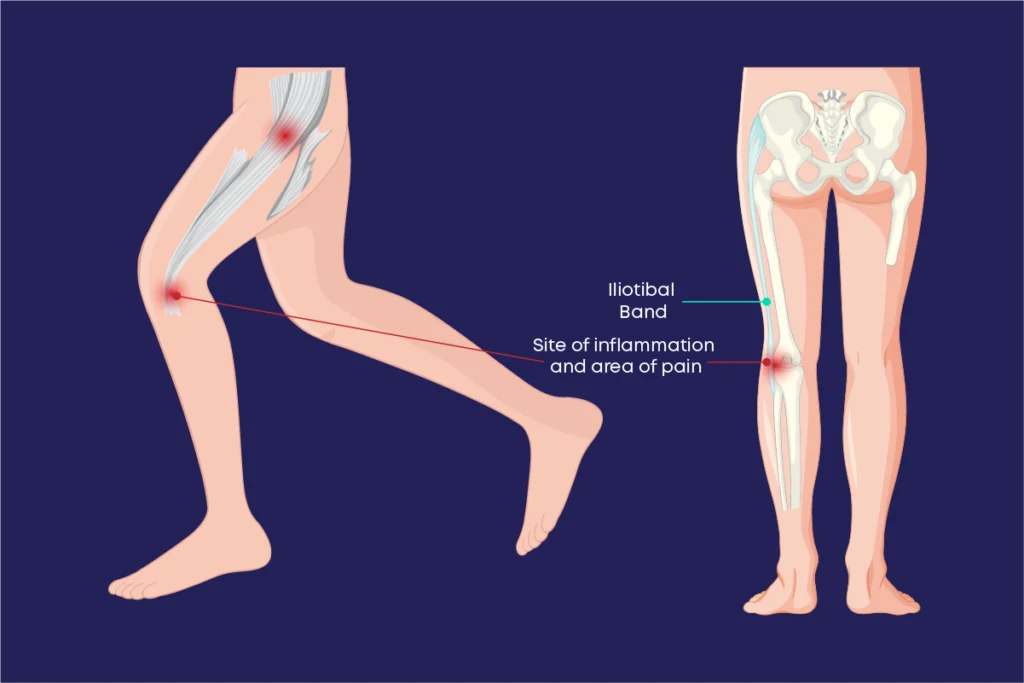
The iliotibial band is a thick strip of connective tissue running along the outer side of your thigh, from your hip down to just below your knee. Unlike a muscle, it doesn’t contract, and it doesn’t stretch. What it does is transmit force, and when the muscles controlling it aren’t doing their job, that force becomes a problem.
When your glutes and hip abductors are weak, your knee drops inward with each stride. This changes the angle at which the IT band passes over the outer knee, creating friction and compression with every step. Do that a few thousand times on a long run, and you have IT band syndrome.
This is why targeting the IT band directly rarely works. The band is just taking the punishment for what’s happening at your hip.
Other factors that contribute include:
- Rapid increases in training mileage without adequate conditioning
- Running on cambered roads or always in the same direction on a track, which loads one side of the body more than the other
- Overpronation at the foot, which passes stress up through the ankle, knee, and hip
- Tight hip flexors from prolonged sitting, which alter how your pelvis moves when you walk or run
Recognising IT Band Syndrome Symptoms
The most telling sign of IT band syndrome is pain that arrives at a predictable point in a run. Many people describe hitting a wall around 20 minutes in. a sharp or burning sensation on the outer knee that forces them to slow down or stop.
Other symptoms to look out for:
- Pain or tenderness on the outer side of the knee, occasionally extending up toward the outer thigh
- Discomfort when walking downstairs or downhill, where the knee stays loaded at a bent angle
- Aching after sitting for long periods with your knees bent, such as after a long drive or a flight
- Tightness along the outer leg that feels like it needs to be stretched but never quite releases
If you catch IT band syndrome early, training around the pain until it becomes severe enough is very detrimental. At that point, the injury is entrenched and takes significantly longer to resolve. Any lateral knee pain that consistently appears during runs is worth addressing immediately rather than waiting to see if it resolves on its own.
IT Band Syndrome Treatment: Stretches and Physiotherapy
IT Band Stretches
The goal of stretching is to release the muscles feeding into it and restore mobility in the hip. Do these stretches daily, particularly after activity and before bed.
Standing crossover stretch: Stand near a wall for balance. Cross your unaffected leg in front of the sore leg and lean your hip out to the side, away from the wall. You should feel a stretch along the outer hip and thigh. Hold for 30 seconds, repeat 3 times on each side.

Figure-four stretch: Lie on your back with both knees bent. Cross the ankle of your affected leg over the opposite knee and gently pull both legs toward your chest until you feel a stretch deep in your glute and outer hip. Hold for 30 seconds, repeat 3 times. Do this 2-3 times daily.
Hip flexor stretch: Kneel on the affected side’s knee with your other foot forward. Shift your weight forward gently until you feel a stretch at the front of your hip. Hold for 30 seconds, repeat 3 times. This is especially important if you spend long hours sitting.
Foam rolling
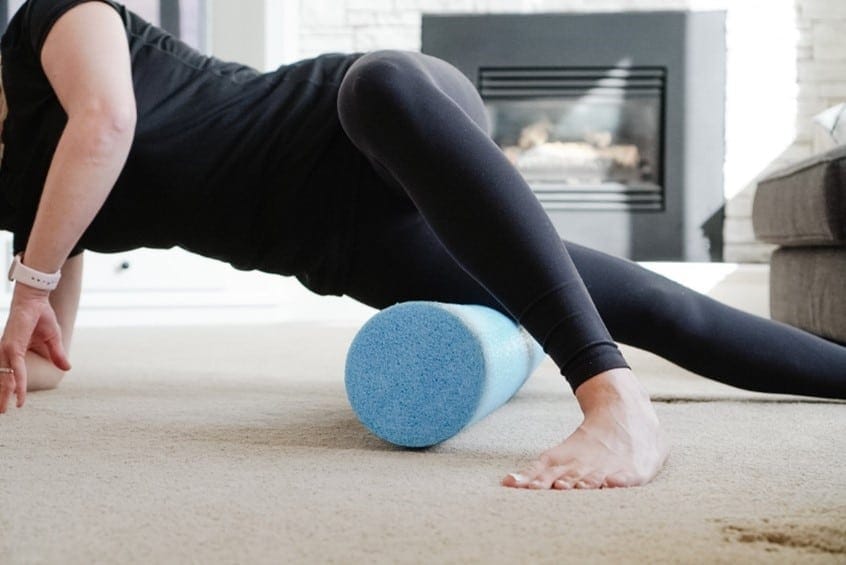
Foam rolling the IT band is the most common self-treatment, and it’s not entirely wrong, but most people do it incorrectly. Rolling directly over the IT band is uncomfortable and achieves very little, because the band itself has almost no give. The more useful approach is rolling the TFL (the small muscle at the very top of the outer thigh, just below your hip) and the outer quad, which are the muscles that actually feed tension into the IT band.
Even done correctly, foam rolling is a short-term relief tool. It reduces tightness before and after activity, but it doesn’t correct the underlying weakness or movement pattern driving the problem.
How Long Does IT Band Syndrome Take to Heal?
Recovery from IT band syndrome happens in stages, and how quickly you move through them depends on how long you’ve had the injury and how consistently you do the work.
In the early stage, the focus is on settling the acute pain. As pain subsides, strengthening becomes the priority. Running is gradually reintroduced using a structured progression. This phase typically runs from weeks three to eight, though this varies considerably.
By the end of the building phase, most people are running without pain and feeling stronger than before the injury. The final stage is maintenance — keeping up a regular strengthening routine to make sure the glutes and hip abductors stay strong enough to protect the IT band long-term.
Chronic IT band syndrome, or injuries that have been present for months without proper treatment, does take longer to resolve. But it still responds well to physiotherapy. The same principles apply; the timeline is simply extended. Patience with the process matters here, because the exercises are correcting movement patterns that have developed over a long time.
FAQ on IT Band Syndrome
Complete rest isn't necessary and is often counterproductive, but continuing to run through pain will extend your recovery time significantly. Reduce or pause running while you begin stretching and strengthening. Low-impact exercise like swimming is fine to continue.
Runner's knee (patellofemoral pain) causes pain at the front of the knee, around or behind the kneecap. IT band syndrome causes pain specifically on the outer side of the knee. Both can affect runners, and both involve hip weakness as a contributing factor, but they're distinct conditions affecting different structures and requiring slightly different treatment approaches.
IT band syndrome is load-dependent. The friction and compression that cause pain build up with repetitive movement over time and distance. A short easy run doesn't accumulate enough stress to trigger symptoms, but a long run does.
If you recover through rest and then return to training without addressing the hip weakness and movement patterns that caused the problem, you'll be back to square one the next time your training load increases. The answer is maintaining a regular hip strengthening routine even when you're pain-free, so the muscles that protect your IT band stay strong enough to do their job.
Get IT Band Syndrome Treatment at Regenesis Sports’ Physiotherapy

IT band syndrome doesn’t have to be a recurring problem that sidelines you every time you build up your training. With the right treatment approach, most cases resolve completely, and with the right maintenance, they don’t come back.
At Regenesis Physiotherapy, our sports physiotherapy specialists will assess exactly what’s driving your IT band injury, whether that’s hip weakness, movement mechanics, training load, or a combination of factors. You’ll leave with a clear plan, the right exercises, and the confidence to return to running, cycling, or whatever activity you’ve been missing.